
FLIGHT LAB / CONSOLE 01
Inside a Flight Test
Six minutes of a research-style scenario: a climb, a level-off and one discrepancy to explain. Scrub the time conductor, compare what the model expected with what the synthetic sensors reported, pick an event, and see which assembly of the Lear it concerns.
Synthetic educational data · lp-ft-001 · authored, generated by code
Not a flight by Lloyd. Not NASA telemetry. Not real-time data, a certified model or a digital twin. Values are generic research-scenario values, not Lear 24XR parameters.
Opening the console…
Open MCT is requested only when this page opens; nothing else on the site loads it.
- Loading the dataset
- Loading Open MCT (openmct.js)
- Registering the synthetic channels
- Starting the console
Events (authored)
Expected vs observed, this window
Waiting for the dataset…
Sends the table above (the numbers this page computed for the current window) and the event’s allowed hypotheses to the site’s assistant, which answers from them with citations. It never receives the authored answer and cannot change it.
Reads every channel at one second of the dataset. Events move it; the telemetry view’s bounds keep it on screen.
Hypotheses (from the dataset)
- Pick an event to see the hypotheses its author allowed.
The reveal reads the authored answer from lp-ft-001.truth.json. No model writes it, and nothing on this page can change it.
Static chart and table (the same dataset without Open MCT) Synthetic educational data
Generated by scripts/gen-lab-dataset.mjs from the same JSON file the console reads. Dashed lines are the expected (model) channels.
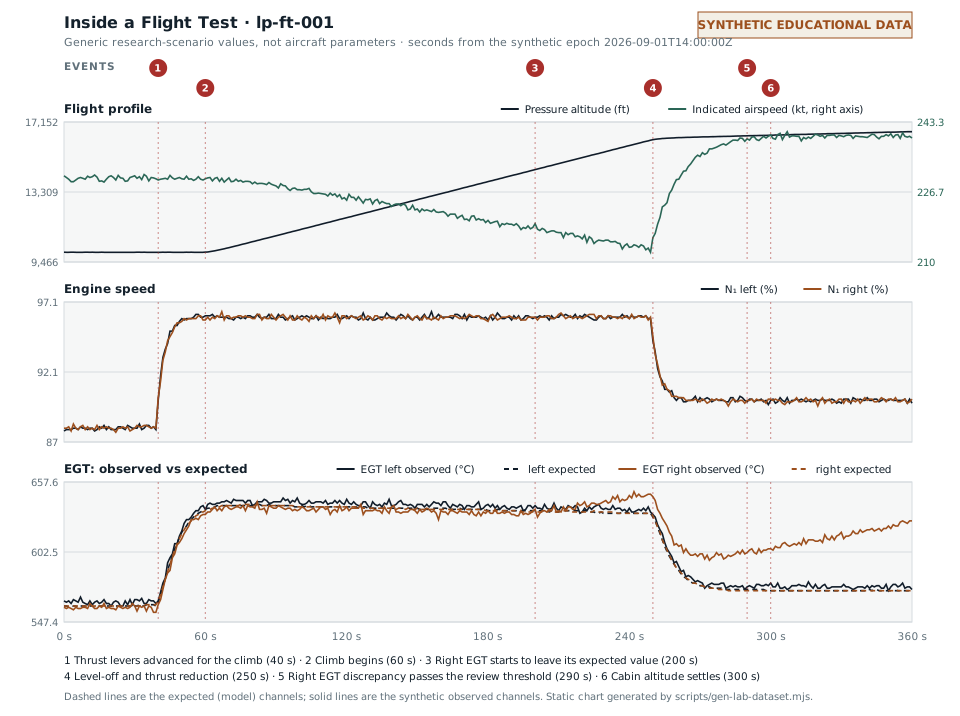
One row every 30 seconds; the JSON file holds all 361 samples at 1 Hz. Units and channel classes are in the column headers.
| t (s) | Time (UTC) | Pressure altitude ft · measured | Indicated airspeed kt · measured | Pitch attitude ° · measured | N₁ left % · measured | N₁ right % · measured | EGT left (observed) °C · measured | EGT left (expected) °C · expected | EGT right (observed) °C · measured | EGT right (expected) °C · expected | Fuel flow left (observed) lb/h · measured | Fuel flow right (observed) lb/h · measured | Cabin altitude ft · measured |
|---|---|---|---|---|---|---|---|---|---|---|---|---|---|
| 0 | 14:00:00 | 10002 | 230.5 | 2 | 87.8 | 88 | 564 | 560 | 559 | 560 | 903 | 893 | 2997 |
| 30 | 14:00:30 | 10001 | 230.5 | 2.1 | 88 | 88 | 565 | 560 | 560 | 560 | 916 | 895 | 3007 |
| 60 | 14:01:00 | 10010 | 229.8 | 3.2 | 96.1 | 95.8 | 636 | 636 | 632 | 635 | 1268 | 1252 | 3001 |
| 90 | 14:01:30 | 10907 | 228.1 | 7.1 | 95.9 | 95.8 | 642 | 639 | 637 | 639 | 1262 | 1251 | 3197 |
| 120 | 14:02:00 | 11899 | 224.7 | 6.9 | 96.1 | 95.9 | 644 | 638 | 638 | 638 | 1253 | 1236 | 3543 |
| 150 | 14:02:30 | 12887 | 222.6 | 7 | 96 | 96.1 | 640 | 637 | 633 | 637 | 1233 | 1227 | 3952 |
| 180 | 14:03:00 | 13879 | 219.9 | 6.8 | 95.8 | 95.7 | 640 | 635 | 635 | 635 | 1236 | 1230 | 4355 |
| 210 | 14:03:30 | 14867 | 217 | 7.1 | 96 | 96.2 | 635 | 634 | 635 | 634 | 1227 | 1219 | 4779 |
| 240 | 14:04:00 | 15858 | 213.5 | 7.1 | 95.9 | 95.9 | 637 | 633 | 647 | 633 | 1218 | 1203 | 5184 |
| 270 | 14:04:30 | 16326 | 235.1 | 2.4 | 90.2 | 89.9 | 579 | 576 | 601 | 576 | 947 | 938 | 5538 |
| 300 | 14:05:00 | 16430 | 240.2 | 2.5 | 90 | 90.1 | 578 | 572 | 605 | 572 | 938 | 932 | 5662 |
| 330 | 14:05:30 | 16525 | 240 | 2.6 | 89.8 | 90.1 | 575 | 572 | 618 | 572 | 953 | 934 | 5702 |
| 360 | 14:06:00 | 16622 | 239.5 | 2.3 | 89.8 | 90.1 | 573 | 572 | 627 | 572 | 943 | 929 | 5757 |
Provenance
- Author: LloydPilot. Generator:
scripts/gen-lab-dataset.mjs(seeded, deterministic; two runs are byte-identical). - Kind: synthetic educational data. It is not a flight by Lloyd or by anyone, not NASA telemetry, not real-time data, not a certified performance model and not a digital twin.
- Values: generic research-scenario values chosen to be readable; not Learjet 24 or N24SA parameters, limits or procedures.
- Software: NASA Ames’ Open MCT 4.3.1 (Apache-2.0), unmodified, loaded only on this page. It visualises; it does not simulate or measure.
Sources and notices
- Open MCT: github.com/nasa/openmct, API.md (“Starting an Open MCT application”, “Telemetry Providers”, “Time API”), package
openmct@4.3.1. Checked 2026-09-07. - The method this exercise is inspired by: NASA Quesst blog, 4 September 2026, “NASA’s X-59 Aircraft Builds Momentum Through 25th Flight” (the “real-time digital twin” comparison). See the research brief.
- Software notices · Open MCT LICENSE · Methods and case study
- Sources / suggest a correction (say hello on Instagram; there is no account or form here).
Educational. Nothing on this page is operating guidance for any airplane; this independent site is not affiliated with or endorsed by NASA.