
INSIDE A VINTAGE LEAR 24 · N24SA · SERIAL 24-117
Inside a vintage Lear 24.
A Learjet 24, pulled apart assembly by assembly in the Aircraft Atlas, with its story told only as far as the records go.
Lear 24XRN24SAserial 24-117Learjet Model 24 on the FAA registry
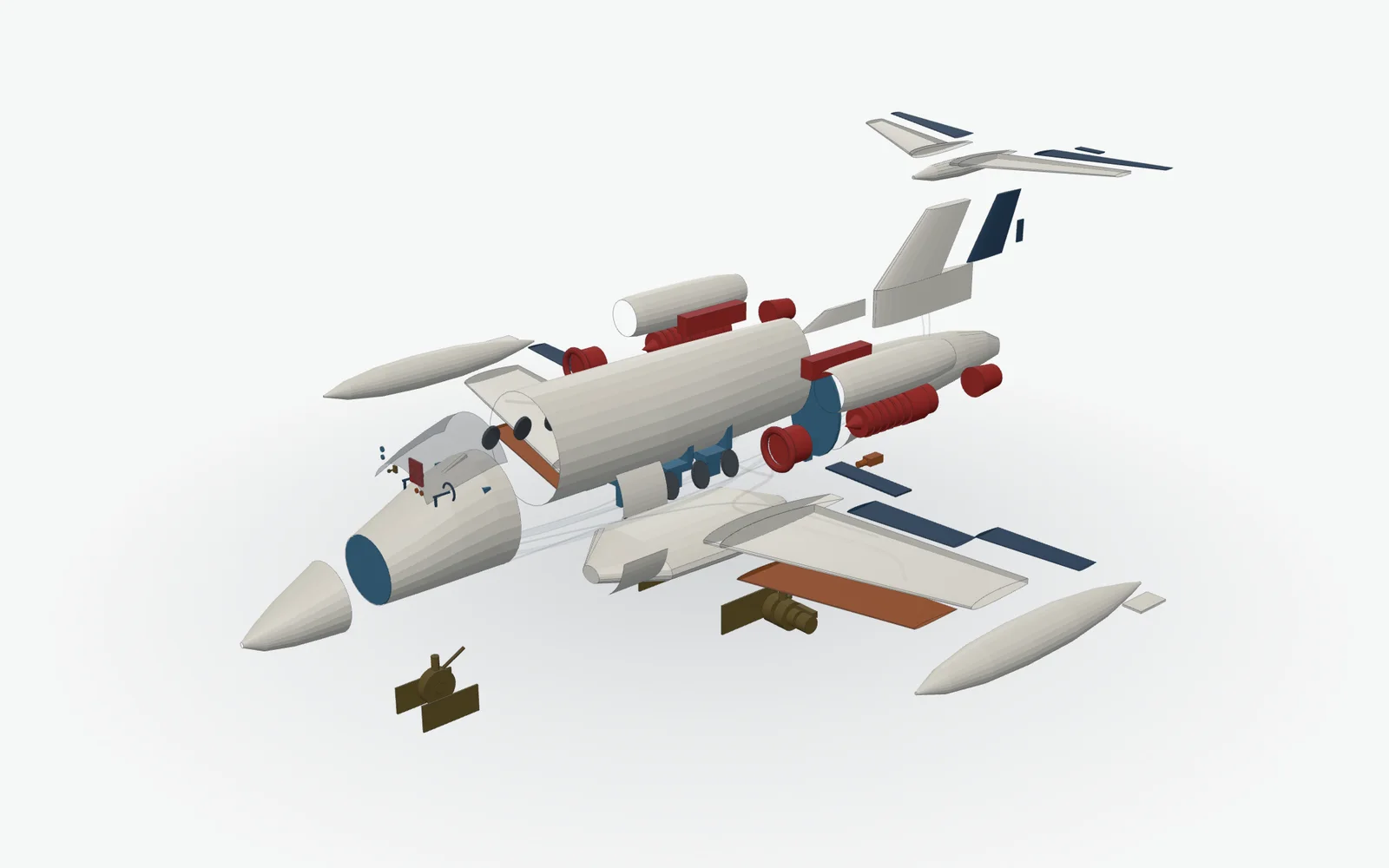 EXPLODED VIEW · INTERACTIVE 3DILLUSTRATIVE MODEL
01 / THREE WAYS IN
Three ways in
Meet N24SA
The registry’s facts, a historical listing’s claims and what nobody has documented, kept apart and labelled.
Read the identity notes ↓ 02Trace a system
Follow fuel from a tip tank to an engine on a guided tour that says, part by part, which pieces are established and which are schematic.
Open the fuel tour in the Atlas ↗ 03How Learjets became flying laboratories
NASA Ames put an infrared telescope in a Learjet’s cabin and flew astronomers above most of the atmosphere’s water vapor. A separate airplane, and a separate chapter.
Read the chapter →02 / MEET N24SA
One airplane, three kinds
of knowing.
“24XR” is the name a historical sales listing gave this airplane. The FAA registry records it as a Learjet Inc. Model 24, serial 24-117. Everything below is sorted by how well it is established, and nothing is promoted from one column to the next.
What the registry records
Manufacturer Learjet Inc. Model 24. Serial number 24-117. Fixed-wing multi-engine, turbojet. Registration N24SA.
The registry’s dates are deliberately not shown here: they describe paperwork, not the airplane. The year of manufacture is not stated by the registry or the listing.
Source: FAA Aircraft Registry, N-number inquiry for N24SA ↗, record fields for manufacturer, model, serial and category, read September 7, 2026.
What a historical listing claimed
A seller’s listing titled “Learjet 24XR” advertised a Dee Howard XR “Extended Range Modifications” kit, Dee Howard thrust reversers, a 45,000 ft altitude kit and CJ-610-6 engines. Its inspection-due dates place it before February 2013, and the page now states that the aircraft is not for sale or available for charter.
Seller’s claims of the time, not an equipment inventory. Nothing on this site shows any of it as installed, and the listing’s photographs are not reused.
Source: aircraft.com listing 200875707 ↗, sections General, Airframe and Additional Equipment.
What nobody has documented
A hush kit. Owner context mentions one; no source read for this page names it, and the listing lists its Dee Howard items without any noise-suppression equipment. Type, operation and status are unknown, so nothing is shown.
Fuel capacity, range, ceiling, engine subvariant, procedures and limitations for this airplane: not stated anywhere on this site, because no applicable record was read. The FAA type certificate data sheet, which would carry some of it for the type, could not be opened.
What is missing is said at the claim, not as a sitewide disclaimer.
What this page does not say. Nothing here describes the airplane’s present condition, equipment or airworthiness, and nothing here offers it for sale, charter or flights. No photographs of N24SA are part of this site; the only picture is the training model above.
03 / A SOURCED TIMELINE
From a Swiss fighter
to a flying laboratory.
Verified means a primary source or applicable record was read directly. Reported means a secondary source says so. Unverified means the sources disagree or say nothing.
-
1955–1962Origins
A Swiss fighter’s bones, a Kansas address Verified
Bill Lear’s Swiss American Aviation Corporation drew on the structural quality of the Swiss FFA P-16 strike fighter for its business jet. In August 1962 the company became Lear Jet Corporation and moved from St. Gallen to Wichita.
A secondary account adds that the P-16 first flew in April 1955 and that its Swiss order was cancelled after a crash. Reported
Sources: Smithsonian NASM, “Lear Jet 23”, long description · Museum of Flight Archives, “Lear Jet Corporation”, biographical note · The Museum of Flight, “Learjet 23” · Aerospaceweb, “Origins of the Learjet” (P-16 details).
-
1963First flight
October 7, 1963: the first Lear Jet flies Verified
The prototype Model 23 made the first flight of a Lear Jet at Wichita. A museum archive dates its FAA type certificate to July 31, 1964; a secondary source adds a first delivery on October 13, 1964, and 101 built before production ended in 1966. Reported
Sources: Smithsonian NASM, “Lear Jet 23”, long description (first flight) · Museum of Flight Archives, biographical note (type certificate) · Wikipedia, “Learjet 23”, Development (delivery, production).
-
1965Announcement
October 1965: the Model 24 is announced Verified
Lear Jet Corporation announced the Model 24, an improved 23, in October 1965.
Source: Museum of Flight Archives, “Lear Jet Corporation”, biographical note.
-
1966The Model 24
The Model 24 flies and is certified, on dates the sources cannot agree on Unverified
Both sources read agree on the year and disagree on the days. Wikipedia: first flight January 24, 1966; FAA certification November 9, 1966. Business Air News: first flight 24 February 1966; certification in March 1966, with the 24A certified 9 November 1966. The FAA type certificate data sheet, A10CE, would settle it; its page on the FAA’s document system could not be read for this site, so the dates stay as a recorded conflict.
What is verified is the certification basis: FAR Part 25, the transport category rules, effective February 1, 1965, as amended by Amendments 25-2 and 25-4, plus special conditions. Type certificate A10CE also covers the 24A through 24F-A and the 25 series. Verified Wikipedia calls the 24 the first business jet certified under FAR Part 25; that claim was not checked against a record. Reported
Sources: Wikipedia, “Learjet 24”, Development · Business Air News handbook, “Learjet 24/25”, Overview and Variant types · NZ CAA Type Acceptance Report, Learjet 35A, certification-basis paragraph citing TCDS A10CE Rev. 67 · 68 FR 9854 (March 3, 2003), title and Type Certification Basis · FAA DRS, TCDS A10CE Rev. 67 (not readable).
-
May 1966Around the world
May 23–26, 1966: a Learjet 24 flies around the world Verified as stated
On a demonstration flight, a Learjet 24 circled the globe. The Frontiers of Flight Museum gives 22,993 miles in 50 hours and 20 minutes of flying time, with 18 world records established or broken; Wikipedia gives the same flying time. Pilot Hank Beaird remembered it as 50 hours and 19 minutes of flying time. A dealer’s description of the Lear archive gives 22,992.8 statute miles in 50 hours and 39 minutes of flight and names the crew as Henry Beaird, Rick King and John O. Lear, with John Zimmerman as observer. Reported
Flying time is not elapsed time. No source read states how long the trip took from first takeoff to final landing, so this page gives no elapsed time and does not treat the 50-hour figures as one. Elapsed time unverified
Sources: Frontiers of Flight Museum, “Learjet Model 24D Aircraft”, description · Wikipedia, “Learjet 24”, Development · Airport Journals, “Conversation with Hank Beaird”, interview · Raab Collection, “William Lear Archive”, description.
-
1966–1980The family
Variants, and the stretched 25 Reported
259 Learjet 24s were built, 99 of them 24Ds, according to the Frontiers of Flight Museum. A trade handbook dates the variants: 24A certified 9 November 1966; 24B approved 17 December 1968 with CJ610-6 engines; 24D certified 17 July 1970; 24E and 24F announced in 1976, with production ending in 1979 and 1980. Per-variant production counts exist only in Wikipedia and are not repeated here.
The Learjet 25 is a stretched 24, 1.27 m (4 ft 2 in) longer with three more seats; it first flew on August 12, 1966, and deliveries began in November 1967.
Sources: Frontiers of Flight Museum, description (production) · Business Air News handbook, Variant types · Wikipedia, “Learjet 25”, Development and Specifications.
-
1967–1990Ownership
Gates, then Bombardier Verified
Bill Lear sold his controlling shares to Gates Rubber in April 1967; the company became Gates Learjet in 1969 and was bought by Bombardier in 1990.
Sources: Museum of Flight Archives, “Lear Jet Corporation”, biographical note · The Museum of Flight, “Learjet 23” (Bombardier).
-
1968–2001Research platforms
Learjets as flying laboratories Verified
In 1968 NASA Ames flew a 12-inch infrared telescope aboard a Learjet 23 at 50,000 feet. In the early 1970s the Learjet Observatory, a Learjet 24B, carried the telescope just in front of the wing; Ames’s 1974 technical report describes typically 70 minutes of observing per flight above 45,000 feet, above most of the water vapor that blocks infrared light from the ground. NASA Dryden later flew a Learjet 24 as an airborne test aircraft until a landing accident in 2001 in which nobody was hurt.
These are different airplanes from N24SA. No telescope, NASA equipment or NASA markings were ever part of N24SA, and none appear on its model.
Sources: NASA, “History of Airborne Astronomy at NASA”, Learjet paragraph and image captions · NASA TM X-62,389, “Lear Jet Telescope System” (1974), Preface p. iv · NASA, “Lear-24”, caption.
Read the chapter: The Learjet that looked at the universe -
TodayN24SA
What the record says about this one Verified
The FAA registry lists N24SA as a Learjet Inc. Model 24, serial 24-117. A historical sales listing, placed before 2013 by its inspection-due dates, called it a Learjet 24XR and advertised Dee Howard modifications. Reported Its year of manufacture is not stated by either source, and nothing here describes its present condition.
Sources: FAA Aircraft Registry, record for N24SA · aircraft.com listing 200875707, General and Additional Equipment.
04 / SOURCES & PROVENANCE
Sources and provenance
Sources & provenance 20 claims · 21 sources
Verified: established by a primary source or applicable record read directly. Reported: stated by a cited source that is not an authoritative record. Unverified: mentioned or contested, not established; never shown as specification.
Spotted an error, or have a document that settles a claim? Suggest a correction
- VerifiedRegistered model and serial
Learjet Inc. Model 24, serial 24-117, fixed-wing multi-engine turbojet. The record’s dates are not shown.
FAA Aircraft Registry, N-number inquiry, record fields.
- Reported“24XR” designation
The title of a historical sales listing; the registry records the model simply as 24. A display name, not a factory or type-certificate model.
aircraft.com listing 200875707, title and General · FAA registry, model field.
- ReportedDee Howard modifications, thrust reversers, altitude kit, CJ-610-6 engines
Seller’s claims in the listing; not current equipment, not verified by any record. The listing’s range and drag-reduction figures are its own marketing and are not repeated.
aircraft.com listing 200875707, Additional Equipment and General.
- UnverifiedHush kit
Owner context only. No source read documents one; the listing names no noise-suppression equipment.
aircraft.com listing 200875707, Additional Equipment (absence).
- UnverifiedYear of manufacture of N24SA
Not stated by the registry or the listing.
FAA registry (field not listed) · listing (no year).
- VerifiedLear Jet origins: SAAC, the P-16 lineage, Wichita 1962
P-16 details (first flight 1955, cancelled order) rest on a secondary article: Reported.
NASM, “Lear Jet 23”, long description · Museum of Flight Archives, agent record · Museum of Flight, “Learjet 23” · Aerospaceweb, “Origins of the Learjet”.
- VerifiedModel 23 first flight, October 7, 1963
NASM, “Lear Jet 23”, long description · Museum of Flight Archives, agent record · Museum of Flight exhibit page.
- ReportedModel 23 type certificate July 31, 1964; first delivery October 13, 1964; 101 built
Museum of Flight Archives, biographical note (certificate) · Wikipedia, “Learjet 23”, Development (delivery, total).
- VerifiedModel 24 announced October 1965
Museum of Flight Archives, biographical note.
- UnverifiedModel 24 first flight and certification dates
Wikipedia: January 24 and November 9, 1966. Business Air News: 24 February 1966, certification March 1966, 24A on 9 November 1966. TCDS A10CE not readable. Published as a conflict; only “1966” is used.
Wikipedia, “Learjet 24”, Development · Business Air News, Overview · FAA DRS, A10CE Rev. 67 (JavaScript shell, unreadable).
- VerifiedCertification basis FAR Part 25 (Feb 1, 1965; Amdts 25-2, 25-4); TC A10CE covers the 24 family and the 25 series
NZ CAA Type Acceptance Report, Learjet 35A, certification-basis paragraph citing TCDS A10CE Rev. 67 (Feb 19, 2015) · 68 FR 9854, title and Type Certification Basis.
- Reported“First business jet certified under FAR Part 25”
Wikipedia, “Learjet 24”, Development. Not checked against a record.
- Verified as statedRound-the-world flight, May 23–26, 1966: 22,993 miles, 50 h 20 min flying time, 18 records
Other accounts: 50 h 19 min (Beaird interview); 22,992.8 statute miles in 50 h 39 min and the crew names (Raab description): Reported. Distance and minutes disagree between sources.
Frontiers of Flight Museum, description · Wikipedia, Development · Airport Journals, interview · Raab Collection, description.
- UnverifiedElapsed time of the round-the-world flight
No source read states it. Not published; the flying-time figures are never presented as elapsed time.
- ReportedLearjet 25: stretched 24, first flight August 12, 1966
Wikipedia, “Learjet 25”, Development and Specifications.
- ReportedProduction: 259 built, 99 of them 24Ds; variant approval dates
Total and 24D count as stated by a museum; the dates from a trade handbook; per-variant counts (Wikipedia only) left out.
Frontiers of Flight Museum, description · Business Air News, Variant types.
- VerifiedGates Rubber April 1967; Gates Learjet 1969; Bombardier 1990
Museum of Flight Archives, biographical note · Museum of Flight, “Learjet 23”.
- VerifiedNASA Ames Learjet observatory: Learjet 23 in 1968; Learjet 24B in the early 1970s; 70 minutes above 45,000 ft (1974 report)
NASA, “History of Airborne Astronomy at NASA”, Learjet paragraph and captions · NASA TM X-62,389, Preface p. iv.
- VerifiedNASA Dryden Lear 24 test aircraft; landing accident June 7, 2001, no injuries
The NTSB records that airplane as a Model 24A (report LAX01TA204); whether it was the same airframe as the Ames observatory rests on a commercial blog and is not asserted.
NASA, “Lear-24”, caption · NTSB Aviation Accident Final Report LAX01TA204, pp. 1–6 (not linked: the hosted file name carries another registration) · Aviation Safety Network record 323277.
- VerifiedSixty years: the Model 24’s first flight, round-the-world flight and certification all fall in 1966
Derived from the entries above; the day-level dates remain unverified, the year does not.
Research date: every source above was read on September 7, 2026. Listing photographs and museum object photographs are not reused; NASA content is used for educational purposes with NASA acknowledged as the source and no NASA insignia.
ABOUT THIS PAGE
Educational. This page describes one airplane as far as public records and cited sources go, and stops where they stop. It is not an equipment list, a valuation, an offer of any kind, or a statement about the airplane’s present condition. The exploded view is a training model, not a manual.
Explore the Lear 24XR in the Aircraft Atlas